No gym membership? No equipment? No problem. Finding the motivation to stay fit at home can be tough, but you don’t need a room full of expensive gear to torch calories and build strength. If you are tired of mindlessly scrolling through endless fitness videos just to find a decent routine, it’s time to simplify your fitness journey.
Below, you’ll find our ultimate HIIT home workout printable designed to give you a high-intensity, full-body burn in under 20 minutes. Just download, print it out, tape it to your wall, and get ready to sweat on your own schedule.
What Is a HIIT Home Workout and Why Does It Work?
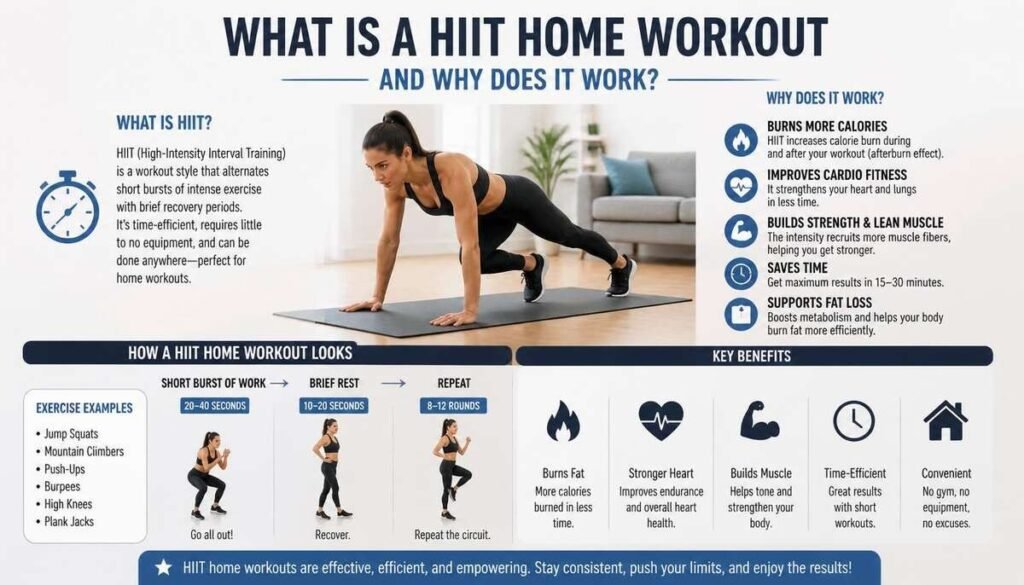
HIIT home workout printable routines have become one of the most searched fitness tools of 2026, and for good reason. HIIT stands for High-Intensity Interval Training, a workout style that alternates short bursts of maximum effort with brief rest periods. Training over the same period.
What makes HIIT especially powerful is the EPOC effect, excess post-exercise oxygen consumption. This means your body keeps burning calories at an elevated rate for hours after the workout ends. You finish training, but your metabolism stays fired up long after you have showered and sat down.
Benefits of HIIT Workouts at Home

HIIT is one of the most time-efficient ways to train both your heart and your muscles at the same time. A well-structured 20 to 30-minute session delivers cardiovascular, metabolic, and strength benefits that rival workouts twice as long. For anyone with a busy schedule, that is a game-changer.
The other major advantage is that you do not need a gym or any equipment. Bodyweight exercises like squats, push-ups, lunges, and mountain climbers are the foundation of most effective HIIT routines. All you need is a small open space, a living room floor, or a bedroom is more than enough to get a serious workout done.
How to Use This HIIT Home Workout Printable

Print this guide and keep it somewhere visible, taped to your wall, on your fridge, or in your gym bag. Having a physical printable in front of you removes decision fatigue and keeps you focused on doing the work rather than planning what to do next.
Follow the structure exactly as written for the first two weeks. Do not skip the warm-up, do not shorten the rest periods, and do not add extra rounds in the beginning. According to fitness experts at Rit Fit Sports, building endurance gradually is far more effective and sustainable than going too hard too fast in the first week.
Warm-Up: Do This Before Every Session (5 Minutes)

Never skip the warm-up. It prepares your muscles, raises your heart rate gradually, and significantly reduces the risk of injury during the high-intensity rounds that follow.
Perform each of the following for 45 seconds with no rest between them:
- Jumping Jacks gets the whole body moving and raises the heart rate
- Leg Swings open up the hips and hamstrings
- Torso Twists activate the core and lower back
- High Knees (slow pace) warms up the legs and gets the blood flowing
By the end of this five-minute warm-up, you should feel warm and slightly breathless, ready to push hard.
The HIIT Home Workout Printable: 20-Minute Full Body Routine
Structure: 40 seconds work / 20 seconds rest Rounds: 3 rounds with 60 seconds rest between rounds Equipment needed: None Space needed: 6 x 6 feet minimum
Round 1 Lower Body Burn
Exercise 1: Bodyweight Squats. Stand with feet shoulder-width apart. Keep your chest up and knees tracking over your toes throughout the movement.
Exercise 2: Reverse Lunges Step one foot back and lower your back knee toward the floor. Alternate legs with each rep and keep the movement controlled rather than rushing.
Exercise 3: Jump Squats Perform a regular squat, then explode upward into a jump.If jumping is too intense, remove the jump and add a calf raise at the top instead.
Round 2 Upper Body and Core
Exercise 4: Push-Ups Hands shoulder-width apart, body in a straight line from head to heels. Lower your chest to the floor and press back up. Drop to your knees if needed — full range of motion is more important than doing it on your toes.
Exercise 5: Mountain Climbers Start in a push-up position. Drive your knees alternately toward your chest as fast as you can while keeping your hips level. This exercise torches the core and keeps the heart rate elevated at the same time.
Exercise 6: Plank Hold a straight-arm or forearm plank for the full 40 seconds. Squeeze your glutes and core, keep your hips level, and breathe steadily. If your form breaks, rest and restart rather than holding a bad position.
Round 3 Full Body Cardio Blast
Exercise 7: Burpees. The most complete bodyweight exercise. Drop your hands to the floor, jump your feet back to a plank, perform a push-up, jump your feet forward, then explode into a jump with arms overhead.
Exercise 8: Lateral Shuffles Lower into a half-squat position and shuffle side to side across the room. Touch the floor with your hand at each end. This exercise targets the inner and outer thighs while keeping the cardio intensity high.
Exercise 9: High Knees Run in place, driving your knees as high as you can with each step. Pump your arms to maintain intensity and rhythm. This is your finisher, give everything you have for the full 40 seconds.
Cool-Down: Do This After Every Session (5 Minutes)
It brings your heart rate down safely, reduces muscle soreness, and improves your flexibility over time.
Hold each stretch for 30 to 45 seconds:
- Forward Fold hinge at the hips, let your arms hang toward the floor
- Hip Flexor Lunge Stretch one knee on the floor, lean forward gently
Weekly HIIT Training Schedule for Beginners
According to Nourish Move Love’s certified personal trainers, beginners should start with two to three HIIT sessions per week with full rest or light activity days between each session. The schedule below is designed to build endurance safely without burning you out.
| Day | Activity |
| Monday | HIIT Session (20 min) |
| Tuesday | Rest or light walk |
| Wednesday | HIIT Session (20 min) |
| Thursday | Rest or gentle stretching |
| Friday | HIIT Session (20 min) |
| Saturday | Active recovery yoga or walk |
| Sunday | Full rest |
After two weeks, add a fourth session or increase work intervals from 40 seconds to 50 seconds. Progress slowly and consistently rather than making big jumps all at once.
How to Progress Your HIIT Workouts Over Time
Most people begin noticing results within two to four weeks of consistent HIIT training, including improved energy, better sleep, and subtle changes in body composition. To keep progressing beyond that point, you need to make the workouts harder over time.
The simplest way to progress is to increase the work interval, decrease the rest period, or add a fourth round to the routine. You can also make individual exercises harder, replace bodyweight squats with jump squats, or replace knee push-ups with full push-ups as your strength improves.
Final Thoughts
A HIIT home workout printable is one of the most practical fitness tools you can have in 2026. It removes every excuse: no gym, no equipment, no complicated planning required. Just print it, clear a small space, and do the work consistently.
Three sessions a week, done with real effort and proper form, will deliver results that hours of casual exercise cannot match. The hardest part is always the first rep. After that, momentum takes over.
Frequently Asked Questions
How many times a week should I do a HIIT home workout?
Beginners should aim for two to three sessions per week with at least one rest day between each session. This allows your muscles and cardiovascular system enough time to recover and adapt. As your fitness level improves after three to four weeks, you can increase to four sessions per week.
Can complete beginners do a HIIT home workout?
Yes. HIIT is fully scalable for beginners. You can reduce the work interval, extend the rest period, and choose low-impact alternatives for any exercise. The key is to work at a high intensity relative to your own fitness level — not to match someone else’s pace or performance.
Do I need any equipment for this HIIT home workout printable?
No equipment is needed at all. Every exercise in this routine uses only your bodyweight. If you have a yoga mat, it will make floor exercises more comfortable, but it is not essential. A 6 x 6 foot clear space is all you need to complete the full session.