Good Mornings Workout looks simple: bend forward, stand back up, but it’s one of the most effective moves for building a strong, resilient posterior chain. It trains the hamstrings, glutes, and lower back all at once, using a single hip-hinge pattern.
Despite a reputation for being risky, good mornings are safe and effective when done with proper form. The key is controlling the hinge, not the amount of weight on the bar.
This guide covers exactly how to do a good morning workout, the muscles it targets, the best variations for your fitness level, and the mistakes that actually cause back strain.
What Exactly Is the Good Morning Exercise?

A good morning is a hip-hinge exercise performed by bending forward at the hips with a weight resting across your upper back, then standing back up. The movement mimics a bow, hence the name.
It’s typically done with a barbell, but dumbbells, kettlebells, resistance bands, or just bodyweight all work, especially for beginners still learning the pattern. Unlike a squat, the knees stay only slightly bent throughout. Nearly all the movement happens at the hips, which is exactly what makes it so effective for isolating the posterior chain.
Good Mornings vs. RDLs: What’s the Difference?
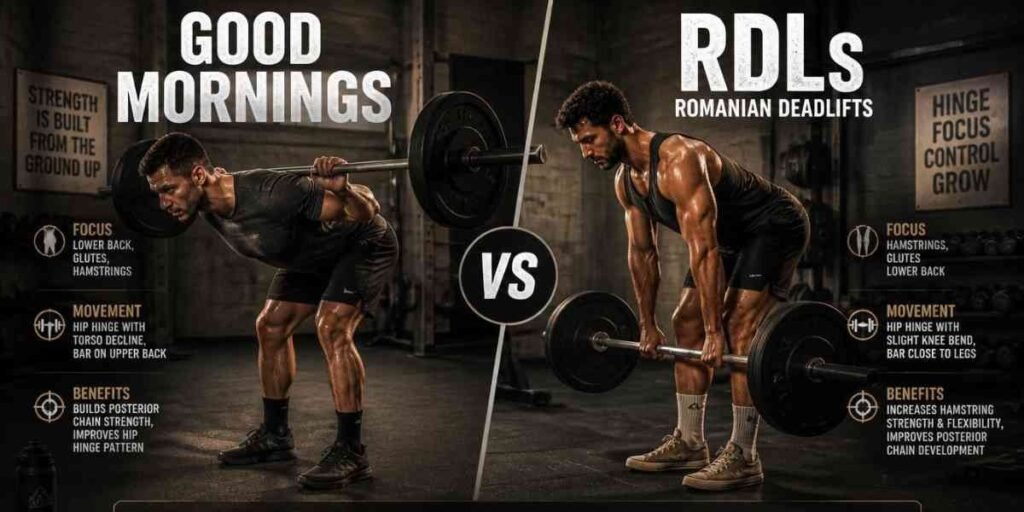
Good mornings and Romanian deadlifts (RDLs) look nearly identical, and both train the same hip-hinge pattern. The real difference is where the load sits.
In a good morning, the weight rests across your upper back, shifting more demand onto your spinal erectors to keep your torso rigid. In an RDL, the weight hangs in your hands, which shifts more of the tension into your hamstrings and grip.Neither move is “better” they’re complementary. Many lifters use RDLs to build raw hamstring strength and good mornings to reinforce spinal stability under load.
How to Do a Good Morning with Proper Form
If using a barbell, rest it across your upper back not your neck similar to a back squat position.
Brace your core, keep your spine neutral, and push your hips back as you hinge forward.
Pause briefly, then drive your hips forward to return to standing, squeezing your glutes at the top. Keep the bar stacked over your midfoot the entire time.
Start with bodyweight or a very light load until your form is consistent. Good mornings punish sloppy technique more than most exercises, so mastering the pattern matters more than adding plates early on.
The Benefits of Doing Good Mornings

Improved Strength
Good mornings build real strength across the hamstrings, glutes, and lower back simultaneously. Because the hamstrings work at a longer muscle length here than in most other hip-hinge moves, the exercise is especially effective for hypertrophy.
Enhanced Posture
Hours spent sitting, typing, or hunched over a phone weaken the posterior chain and pull posture forward. Good mornings directly counteract that by strengthening the muscles that hold your spine upright.
With consistent training, this can mean less lower back pain and better posture throughout the day not just during workouts.
Better Movement Quality
Good mornings teach and reinforce the hip-hinge pattern that underlies squats, deadlifts, and countless everyday movements like picking something up off the floor.
What Muscles Does the Good Morning Exercise Working?
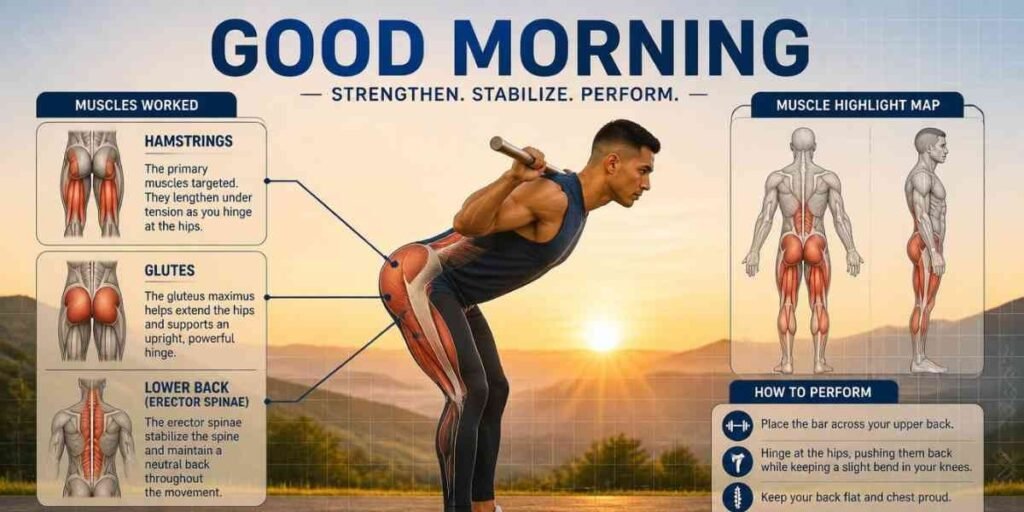
Hamstrings
The hamstrings are the primary muscle group trained by good mornings. As you hinge forward, they stretch under load and control the descent — the same lengthened-position loading that makes this move so effective for hamstring growth.
Back Muscles
Your erector spinae the muscles running along either side of your spine — work isometrically throughout the movement to keep your back straight and prevent rounding. This is a major part of why good mornings build spinal resilience.
Glutes and Core
Your glutes drive the hip extension that brings you back to standing, especially through the top portion of the movement. Meanwhile, your entire core braces to stabilize your spine under the load.
Good Mornings Variations

Dumbbell good mornings Hold a dumbbell against your chest or at your sides instead of a barbell. This is a beginner-friendly way to learn the pattern with less setup than a rack.
Kettlebell good mornings are similar to the dumbbell version, but the kettlebell’s shape makes it easy to hold close to the chest for better control.
Band good mornings. Loop a resistance band under your feet and around your upper back. Bands add resistance progressively through the range of motion, which is gentler on the joints than a fixed weight.
Seated good mornings Performed sitting down, this variation removes the legs from the equation and isolates the lower back and hips. It’s a good option for anyone with limited standing mobility.
Smith machine good mornings The fixed bar path adds stability for lifters still building confidence in the movement, though it removes some of the natural balance demand of a free barbell.
No-weight (bodyweight) good mornings The starting point for beginners.
Good Mornings Workout: Sets, Reps & Programming

Begin with 2–3 sets of 8–12 reps using a weight you can fully control. Quality matters far more than load here; every rep should look identical before you add more weight.
Place good mornings before quad-dominant exercises like squats on leg day, since fatigued legs make it harder to maintain the hinge pattern safely.
Rest 60–90 seconds between sets, and progress gradually adding a small amount of weight or an extra set every couple of weeks once your form is locked in.
Read also this article: Good Mornings Workout: Sets, Reps & Programming
Common Mistakes to Avoid in a Good Morning Workout

Rounding the back. This is the single biggest risk in the exercise. If you feel your spine curving instead of staying neutral, the weight is too heavy or your hamstring mobility needs more work first.
Going too low. Bending all the way to parallel isn’t necessary and increases spinal strain. Stop where you feel a strong hamstring stretch without losing your neutral spine.
Locking the knees. Keep a slight bend throughout. Locked knees put unnecessary stress on the joint and disconnect the hamstrings from the movement.
Rushing the load. Good mornings punish ego lifting more than most exercises. Master the bodyweight or light-load version before adding real weight to the bar.
Also Read: Why the Good Morning Exercise Is Your Back’s Best Friend
Final Thoughts: Morning Workout
The good morning is one of the most underrated posterior-chain exercises out there,
simple in setup, but demanding real technique to get right. Once you’ve got the hinge pattern locked in, it pays off in stronger hamstrings, a more stable spine, and better performance in nearly every other lower-body lift.
Start light, whether that’s bodyweight, a dumbbell, or a resistance band, and build up gradually. Given the right progression, good mornings can become one of the most valuable moves in your entire strength routine.
FAQ SECTION Mornings Workout
What is a good morning workout?
A Mornings Workout is a hip-hinge exercise that strengthens the hamstrings, glutes, and lower back by bending forward at the hips with a weight across the upper back, then standing back up.
Are good mornings bad for your back?
No when performed with proper form and controlled load, good mornings actually strengthen the back and can reduce lower back pain over time.
What’s the difference between good mornings and RDLs?
The load position is the main difference: good mornings carry the weight across the upper back, while RDLs hold it in the hands, shifting emphasis slightly between the erectors and hamstrings.