Knowing how to have a good morning is only half the equation. Good Mornings Workout: Sets, Reps & Programming. Where it fits in your week, how heavy you load it, and how many reps you actually run all decide whether the exercise builds real strength or just becomes a box you tick on leg day.
Good mornings are an accessory movement for almost everyone. That single fact shapes nearly every programming decision that follows from set count to how often you train it. This guide breaks down exactly how to program good mornings by goal, training level, and weekly structure, with sample plans you can drop straight into your routine.
How Good Mornings Are Typically Programmed

Good Mornings Workout: Sets, Reps & Programming are almost always used as an accessory lift, not a primary strength movement. Training them for a true 1–3 rep max is not recommended the injury risk at very heavy loads outweighs the strength benefit, since the lower back holds most of the tension.
Instead, good mornings work best in one of three programming roles: a submaximal strength accessory, a high-volume accessory for weak points, or a hypertrophy-focused posterior chain builder. Which role you use depends entirely on your training goal: strength, muscle growth, or fixing a specific weakness in your hips and lower back.
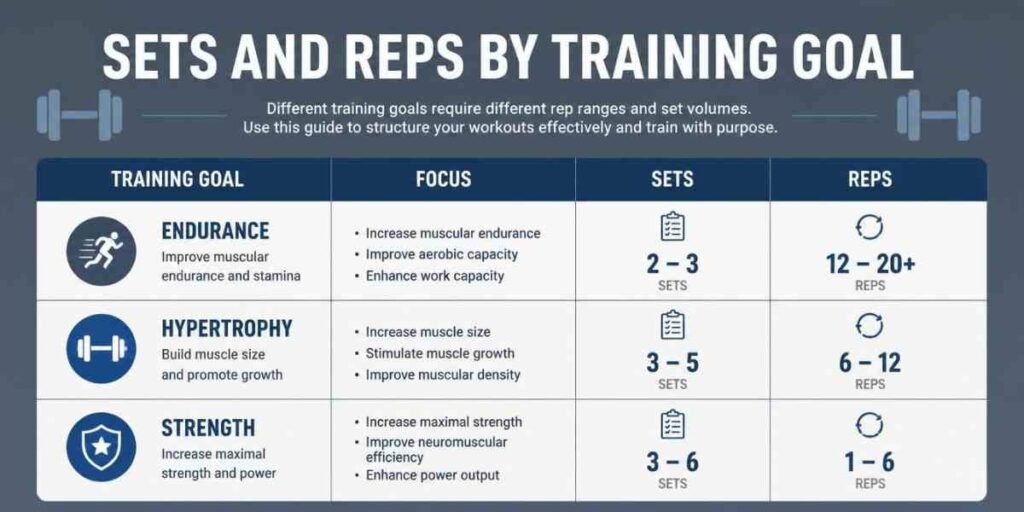
Sets & Reps by Training Goal
Strength-Focused Accessory
If your main goal is building raw strength that carries over to your deadlift and squat, program good mornings as a submaximal accessory: 3–5 sets of 5–8 reps.
Load these heavy enough to feel challenging by the last 2 reps of each set, but never so heavy that your back rounds or your form breaks down.
Hypertrophy (Muscle Growth)
For building bigger hamstrings, glutes, and lower back muscles, aim for 3–4 sets of 8–12 reps with moderate weight.
Hypertrophy can happen across a broader rep range too, as long as sets are genuinely challenging — so don’t feel locked into exactly 8–12 if 10–15 feels more sustainable for your joints.
High-Volume Accessory (Weak Point Training)
If you have a specific weakness in your glutes or lower back, or you’re returning from injury, use a higher-volume, lighter-load approach: 2–4 sets of 10–15 reps.
This role prioritizes total volume and controlled reps over heavy loading, which makes it a safer entry point if you’re newer to the movement.
Programming Good Mornings by Training Level
Beginners should start with bodyweight or very light dumbbell good mornings, focusing entirely on the hip-hinge pattern. Once form is consistent for 3 sets of 10–12 reps, a light barbell load is the natural next step.
Intermediate lifters typically use good mornings 1–2 times per week as a posterior chain accessory, most often in the hypertrophy or high-volume roles described above, paired with squats or deadlifts.
Advanced lifters, especially in powerlifting-style programs, may use good mornings as a primary accessory on a heavy lower-body day 3–5 sets of 5–8 reps at a genuinely challenging load, still stopping well short of a true 1-rep max attempt.
Where Good Mornings Fit in a Workout

Good Mornings Workout: Sets, Reps & Programming before quad-dominant lifts like squats whenever possible. Fatigued legs make it noticeably harder to maintain a clean hip-hinge, which is exactly when form breaks down and injury risk rises.
Good mornings pair naturally with squats or deadlifts on the same training day, since all three reinforce related movement patterns without directly competing for the same muscle groups in the same set.
Rest 60–90 seconds between sets for accessory work, or up to 2 minutes if you’re using the heavier, lower-rep strength-focused approach.
How Often to Train Good Mornings
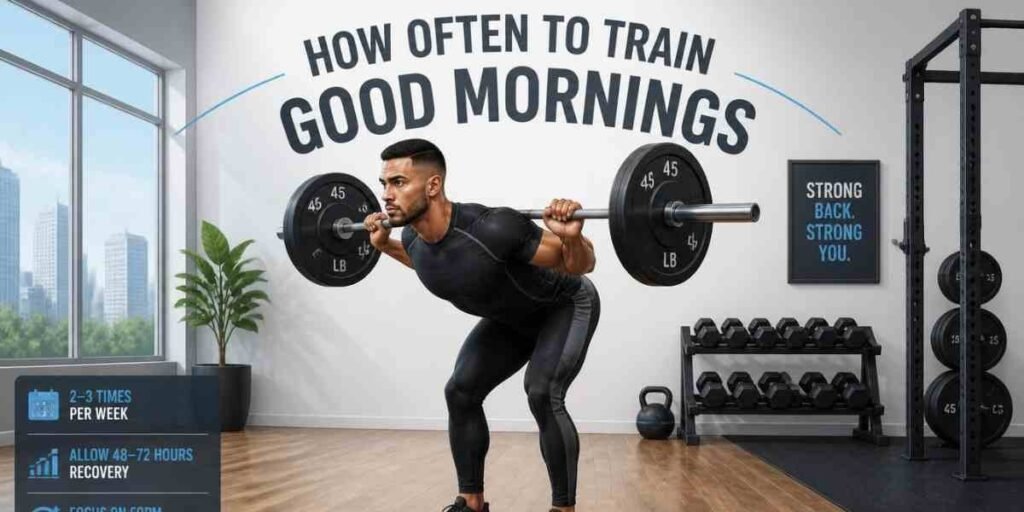
One to two sessions per week is the standard recommendation for most lifters. Because good mornings place significant stress on the lower back and posterior chain, more frequent training raises injury risk without a proportional return in strength or size.
If you’re already doing heavy deadlifts or RDLs elsewhere in your week, one good morning session is usually enough the posterior chain doesn’t need to be hammered from every angle at once.
Progressive Overload for Good Mornings
Progress by adding either reps or load, not both at once. A simple double-progression model works well….
For example, if you’re working in the 8–12 rep hypertrophy range: once you hit 3 sets of 12 reps, add 2.5–5 kg and reset to 3 sets of 8, building back up from there.Track your sets, reps, and load in a training log. Good mornings are technical enough that “just add weight every week” tends to break down form faster than it builds strength.
Sample Weekly Programming

Beginner (2x/week, hypertrophy focus): Monday Bodyweight or light dumbbell good mornings, 3 sets of 10–12 reps Thursday Same load, focus on tightening form before adding weight next week
Intermediate (1x/week, paired with squats): Leg Day Good mornings 3 sets of 8–12 reps (before squats), then Back Squat 4 sets of 6–8 reps
Advanced (1x/week, strength-focused accessory): Heavy Lower Day Deadlift or Squat (main lift), then Good Mornings 4 sets of 5–8 reps as a heavy accessory
Final Thoughts
The good morning rewards patience in programming just as much as it rewards patience in form. Pick the role that matches your goal strength, hypertrophy, or high-volume weak-point work and let the sets and reps follow from there rather than guessing.
Keep the frequency to 1–2 sessions a week, place it before your quad-dominant lifts, and progress slowly with a simple double-progression model. Over months, that consistency builds a stronger, more resilient posterior chain than chasing heavy singles ever will.
FAQ SECTION
How many sets and reps of good mornings should I do?
It depends on your goal: 3–5 sets of 5–8 reps for strength, 3–4 sets of 8–12 reps for hypertrophy, or 2–4 sets of 10–15 reps for high-volume weak-point training.
How often should I do good mornings?
One to two times per week is standard, since the exercise places significant stress on the lower back and posterior chain.
Should good mornings come before or after squats?
Placing good mornings after squats, when your legs are already fatigued, makes it harder to maintain safe hip-hinge form.